Fildonrien
Publikum
- 0 tabs
- 0 kommentarer
- 0 foruminnlegg
Casino sign on bonus guide for GB players
Understanding the casino sign on bonus through a veteran’s eyes

The industry changes fast. I have watched platforms rise and fall like tides along the British coast, yet the fundamental mechanics of player acquisition remain stubbornly consistent in their complexity.
A win place casino might offer you a shiny package to get you through the door, but the real work begins once you click that final confirmation button and the terms start to matter more than the headline figure.
Most newcomers see only the bold numbers. They miss the fine print that dictates whether those numbers ever turn into withdrawable cash, which is where experience separates the hopeful from the informed.
What actually counts as a sign-up offer?
It is rarely simple cash. The typical casino sign on bonus comes wrapped in layers of conditions that protect the operator while giving the player a taste of the action without immediate financial risk.
You might see a match on your first deposit, where the site adds a percentage of what you put in, or perhaps a bundle of free spins on a specific slot game that has been selected for its volatility and appeal.
These offers are marketing tools, not gifts. They are designed to extend your playtime and familiarise you with the interface, ensuring you understand the rhythm of the games before you commit significant personal funds.
The key is to view them as extended trials. You are testing the water, checking the speed of the software and the clarity of the rules, rather than expecting an instant windfall that pays your rent.
Why do operators attach wagering requirements?
Money must be played through. This is the single most misunderstood aspect of online gambling promotions, and it is the primary reason why so many players feel misled when they try to withdraw their winnings.
A wagering requirement tells you how many times you must bet the bonus amount, or sometimes the sum of the deposit plus the bonus, before the funds convert to real money that you can take out of the account.
If you receive fifty pounds in bonus funds with a twenty-times wagering requirement, you must place bets totalling one thousand pounds before that fifty becomes yours to keep. It sounds straightforward until you realise that slots drain balances quickly.
Operators use these requirements to manage their risk. Without them, everyone would deposit, take the free money, and leave, which would make the business model unsustainable within a week of opening.
Always check the contribution rates. Not all games count equally towards meeting these targets, with table games often contributing far less than slots, meaning you might need to wager significantly more if you prefer roulette or blackjack.
How does verification affect your bonus?
Identity checks come first. The days of playing anonymously are long gone, replaced by strict protocols that require proof of who you are before any real value can be accessed.
Licensed operators must verify a customer’s age and identity before allowing deposits, free-to-play games, or gambling with bonus funds. This is not a suggestion; it is a legal mandate under the Gambling Act 2005.
You cannot use a sign-up bonus to bypass this step. If you try to claim a reward before uploading your documents, the system will simply block you, leaving your bonus funds frozen in limbo until the compliance team approves your profile.
This process protects everyone. It prevents underage gambling and ensures that the person playing is the person who owns the payment method, reducing fraud and keeping the market clean for legitimate participants.
Have your documents ready. A driving licence or passport and a recent utility bill are standard requests, and having them scanned and ready to upload saves hours of frustration when you are eager to start playing.
Which payment methods work best?
Speed matters here. The method you choose to fund your account can influence how quickly you can access your bonus and, later, how fast you can withdraw your winnings.
Credit cards are banned for gambling in the United Kingdom. This is a hard rule enforced by the regulator, so do not attempt to use them, as the transaction will be declined and may flag your account for review.
Debit cards remain the most common choice. They link directly to your bank account, providing a clear trail of spending that helps with personal budgeting and satisfies the transparency requirements of the licensing authority.
Digital wallets offer convenience. PayPal and Apple Pay are widely accepted and allow for rapid transfers, often processing deposits instantly and withdrawals much faster than traditional bank transfers, which can take several working days.
Prepaid options provide control. Paysafecard allows you to spend only what you have loaded onto the voucher, creating a natural barrier against overspending and helping you stick to a predetermined budget for your session.
What safety nets must be in place?
Protection is mandatory. The UK Gambling Commission requires operators to provide tools that help players stay in control, and these features are just as important as the games themselves.
You must be offered the chance to set a deposit limit before your first deposit. From June 2026, these limits will be based strictly on the amount paid into the account over a set period, ensuring clarity on what you are actually spending.
Operators must remind you every six months to review your account and transaction information. This regular check-in is designed to prompt reflection on your habits and encourage responsible behaviour before issues arise.
Time-out functionality is standard. If you feel the need to step back, you can pause your account for a set period, during which you cannot log in or place bets, giving you space to regain perspective.
GamStop provides a broader solution. This national online self-exclusion scheme allows you to block yourself from all licensed gambling sites in Great Britain with a single registration, offering a comprehensive break if needed.
Affordability checks are becoming routine. Operators monitor for markers of harm and may ask for evidence of income if your spending patterns suggest financial stress, ensuring that gambling remains a leisure activity, not a burden.
Where do regional differences matter?
Geography defines legality. The rules that apply in England, Wales and Scotland do not automatically extend to Northern Ireland, which operates under separate legislative arrangements for gambling.
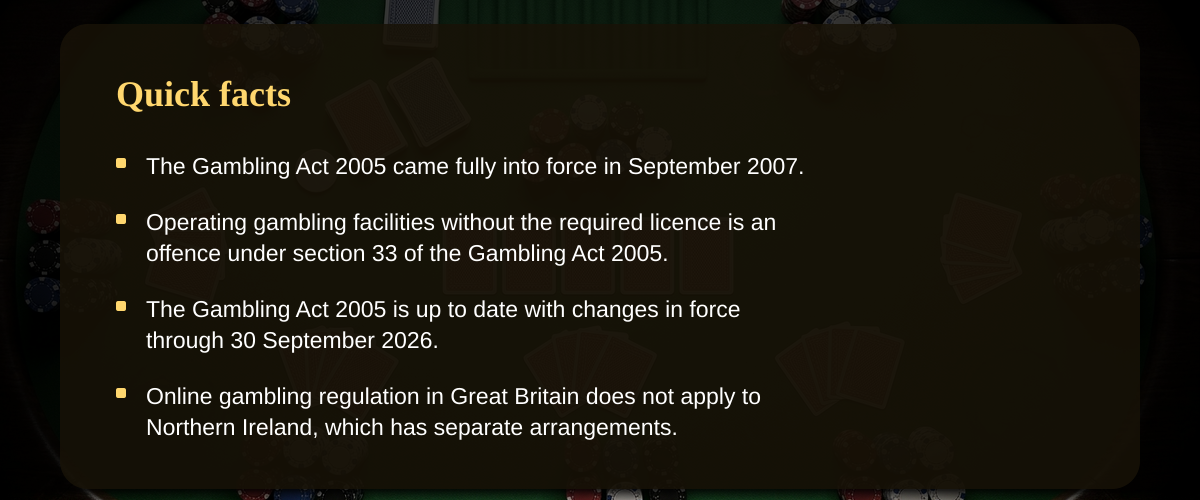
The Gambling Act 2005 governs the market in Great Britain. It came fully into force in September 2007 and has been updated regularly, with the latest changes ensuring that remote operators meet high standards of consumer protection.
Operators serving British customers must hold a Gambling Commission licence. This applies regardless of where the company is based, meaning that even offshore entities must comply with local laws if they wish to advertise to or accept players from this jurisdiction.
Operating without a licence is an offence. Section 33 of the Gambling Act 2005 makes it illegal to provide gambling facilities without the proper authorisation, protecting players from unregulated and potentially unsafe platforms.
Taxation is favourable for players. Online gambling winnings are generally not subject to UK income tax, meaning that what you win is yours to keep, provided it is not generated through professional trading activities.
How should a newcomer approach the first deposit?
Start small always. There is no glory in depositing a large sum on your first day, especially when you are still learning the nuances of the platform and the specific games on offer.
Use the bonus to explore. Treat the extra funds as a way to test different slots or table games without risking your own capital, paying attention to which interfaces you find intuitive and enjoyable.
Read the terms thoroughly. It is boring, yes, but knowing the maximum bet limits while using bonus funds is crucial, as exceeding them can void your winnings and lead to the confiscation of the bonus balance.
I recall a young punter who deposited five hundred pounds on day one, eager to chase a massive jackpot. He ignored the wagering requirements and bet too high on a progressive slot, losing everything in minutes because he did not understand the volatility.
He could have played for weeks with a smaller stake. Instead, he learned a harsh lesson about patience and the importance of understanding the mechanics before committing significant resources to the wheel.
The industry is built on entertainment. When you approach it with caution and knowledge, it can be a pleasant pastime, but when you rush in blind, the house always wins because it understands the rules better than you do.
Understanding the casino sign on bonus through a veteran’s eyes
The industry changes fast. I have watched platforms rise and fall like tides along the British coast, yet the fundamental mechanics of player acquisition remain stubbornly consistent in their complexity.
A win place casino might offer you a shiny package to get you through the door, but the real work begins once you click that final confirmation button and the terms start to matter more than the headline figure.
Most newcomers see only the bold numbers. They miss the fine print that dictates whether those numbers ever turn into withdrawable cash, which is where experience separates the hopeful from the informed.
What actually counts as a sign-up offer?
It is rarely simple cash. The typical casino sign on bonus comes wrapped in layers of conditions that protect the operator while giving the player a taste of the action without immediate financial risk.
You might see a match on your first deposit, where the site adds a percentage of what you put in, or perhaps a bundle of free spins on a specific slot game that has been selected for its volatility and appeal.
These offers are marketing tools, not gifts. They are designed to extend your playtime and familiarise you with the interface, ensuring you understand the rhythm of the games before you commit significant personal funds.
The key is to view them as extended trials. You are testing the water, checking the speed of the software and the clarity of the rules, rather than expecting an instant windfall that pays your rent.
Why do operators attach wagering requirements?
Money must be played through. This is the single most misunderstood aspect of online gambling promotions, and it is the primary reason why so many players feel misled when they try to withdraw their winnings.
A wagering requirement tells you how many times you must bet the bonus amount, or sometimes the sum of the deposit plus the bonus, before the funds convert to real money that you can take out of the account.
If you receive fifty pounds in bonus funds with a twenty-times wagering requirement, you must place bets totalling one thousand pounds before that fifty becomes yours to keep. It sounds straightforward until you realise that slots drain balances quickly.
Operators use these requirements to manage their risk. Without them, everyone would deposit, take the free money, and leave, which would make the business model unsustainable within a week of opening.
Always check the contribution rates. Not all games count equally towards meeting these targets, with table games often contributing far less than slots, meaning you might need to wager significantly more if you prefer roulette or blackjack.
How does verification affect your bonus?
Identity checks come first. The days of playing anonymously are long gone, replaced by strict protocols that require proof of who you are before any real value can be accessed.
Licensed operators must verify a customer’s age and identity before allowing deposits, free-to-play games, or gambling with bonus funds. This is not a suggestion; it is a legal mandate under the Gambling Act 2005.
You cannot use a sign-up bonus to bypass this step. If you try to claim a reward before uploading your documents, the system will simply block you, leaving your bonus funds frozen in limbo until the compliance team approves your profile.
This process protects everyone. It prevents underage gambling and ensures that the person playing is the person who owns the payment method, reducing fraud and keeping the market clean for legitimate participants.
Have your documents ready. A driving licence or passport and a recent utility bill are standard requests, and having them scanned and ready to upload saves hours of frustration when you are eager to start playing.
Which payment methods work best?
Speed matters here. The method you choose to fund your account can influence how quickly you can access your bonus and, later, how fast you can withdraw your winnings.
Credit cards are banned for gambling in the United Kingdom. This is a hard rule enforced by the regulator, so do not attempt to use them, as the transaction will be declined and may flag your account for review.
Debit cards remain the most common choice. They link directly to your bank account, providing a clear trail of spending that helps with personal budgeting and satisfies the transparency requirements of the licensing authority.
Digital wallets offer convenience. PayPal and Apple Pay are widely accepted and allow for rapid transfers, often processing deposits instantly and withdrawals much faster than traditional bank transfers, which can take several working days.
Prepaid options provide control. Paysafecard allows you to spend only what you have loaded onto the voucher, creating a natural barrier against overspending and helping you stick to a predetermined budget for your session.
-
[*]Debit cards offer direct bank linkage and broad acceptance across all licensed sites.
[*]PayPal provides an extra layer of privacy and typically faster withdrawal processing times.
[*]Apple Pay allows for quick mobile transactions using biometric authentication for security.
[*]Paysafecard helps enforce strict budget limits by restricting spend to the prepaid amount.
What safety nets must be in place?
Protection is mandatory. The UK Gambling Commission requires operators to provide tools that help players stay in control, and these features are just as important as the games themselves.
You must be offered the chance to set a deposit limit before your first deposit. From June 2026, these limits will be based strictly on the amount paid into the account over a set period, ensuring clarity on what you are actually spending.
Operators must remind you every six months to review your account and transaction information. This regular check-in is designed to prompt reflection on your habits and encourage responsible behaviour before issues arise.
Time-out functionality is standard. If you feel the need to step back, you can pause your account for a set period, during which you cannot log in or place bets, giving you space to regain perspective.
GamStop provides a broader solution. This national online self-exclusion scheme allows you to block yourself from all licensed gambling sites in Great Britain with a single registration, offering a comprehensive break if needed.
Affordability checks are becoming routine. Operators monitor for markers of harm and may ask for evidence of income if your spending patterns suggest financial stress, ensuring that gambling remains a leisure activity, not a burden.
Where do regional differences matter?
Geography defines legality. The rules that apply in England, Wales and Scotland do not automatically extend to Northern Ireland, which operates under separate legislative arrangements for gambling.
The Gambling Act 2005 governs the market in Great Britain. It came fully into force in September 2007 and has been updated regularly, with the latest changes ensuring that remote operators meet high standards of consumer protection.
Operators serving British customers must hold a Gambling Commission licence. This applies regardless of where the company is based, meaning that even offshore entities must comply with local laws if they wish to advertise to or accept players from this jurisdiction.
Operating without a licence is an offence. Section 33 of the Gambling Act 2005 makes it illegal to provide gambling facilities without the proper authorisation, protecting players from unregulated and potentially unsafe platforms.
Taxation is favourable for players. Online gambling winnings are generally not subject to UK income tax, meaning that what you win is yours to keep, provided it is not generated through professional trading activities.
How should a newcomer approach the first deposit?
Start small always. There is no glory in depositing a large sum on your first day, especially when you are still learning the nuances of the platform and the specific games on offer.
Use the bonus to explore. Treat the extra funds as a way to test different slots or table games without risking your own capital, paying attention to which interfaces you find intuitive and enjoyable.
Read the terms thoroughly. It is boring, yes, but knowing the maximum bet limits while using bonus funds is crucial, as exceeding them can void your winnings and lead to the confiscation of the bonus balance.
I recall a young punter who deposited five hundred pounds on day one, eager to chase a massive jackpot. He ignored the wagering requirements and bet too high on a progressive slot, losing everything in minutes because he did not understand the volatility.
He could have played for weeks with a smaller stake. Instead, he learned a harsh lesson about patience and the importance of understanding the mechanics before committing significant resources to the wheel.
-
[*]Set a strict budget before you open the banking page and stick to it regardless of outcomes.
[*]Verify your account immediately to avoid delays when you eventually want to withdraw funds.
[*]Check the game contributions to ensure your preferred titles help meet wagering requirements efficiently.
[*]Use the time-out feature if you feel your emotions influencing your decisions rather than logic.
The industry is built on entertainment. When you approach it with caution and knowledge, it can be a pleasant pastime, but when you rush in blind, the house always wins because it understands the rules better than you do.